Agentic Coding: GSD vs Spec Kit vs OpenSpec vs Taskmaster AI — Where SDD tools diverge
Note: this text is a Portuguese translation of the original article by Rick Hightower, published in Spillwave Solutions.
Original article: Agentic Coding: GSD vs Spec Kit vs OpenSpec vs Taskmaster AI: Where SDD Tools Diverge
Agentic Coding: GSD vs Spec Kit vs OpenSpec vs Taskmaster AI — Where SDD tools diverge
A deep dive into how GSD, Spec Kit, OpenSpec, and Taskmaster AI approach spec-driven development, and where their philosophies diverge — Article 3 of 3 in the GSD Series
Spec Driven Development — Context Engineering driven development
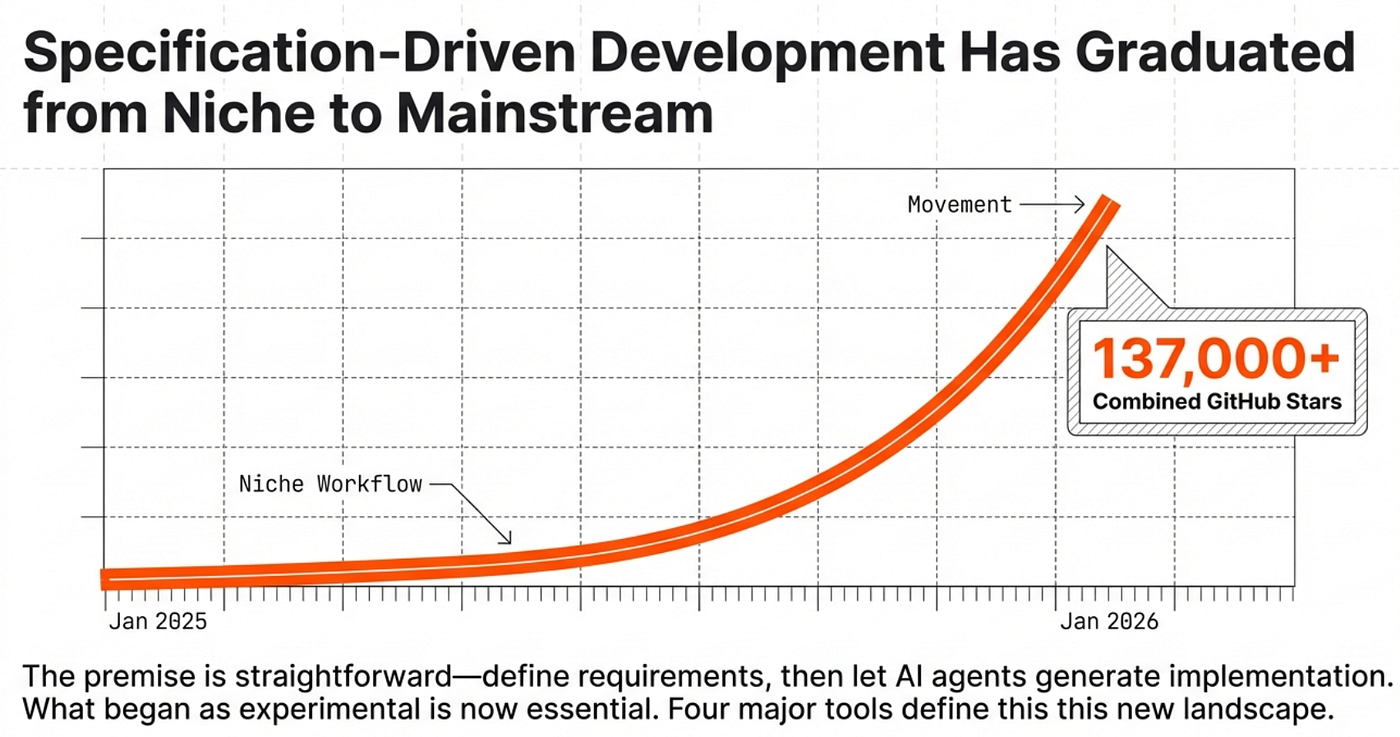
Spec-driven development has become mainstream. The premise is simple: define what you want before writing code, then let AI agents generate implementation from structured specifications. In early 2025, this was a niche workflow. In early 2026, four spec-driven development tools with a combined total of more than 137,000 GitHub stars have turned this into a movement.
But “spec-driven” means different things to different projects. Some tools focus on specification purity. Others optimize for execution orchestration. Some prioritize platform breadth. Others go deep into context engineering. This comparison of AI coding workflow tools for 2026 maps the landscape, profiles each tool honestly, and identifies where they diverge.
The Shared Premise
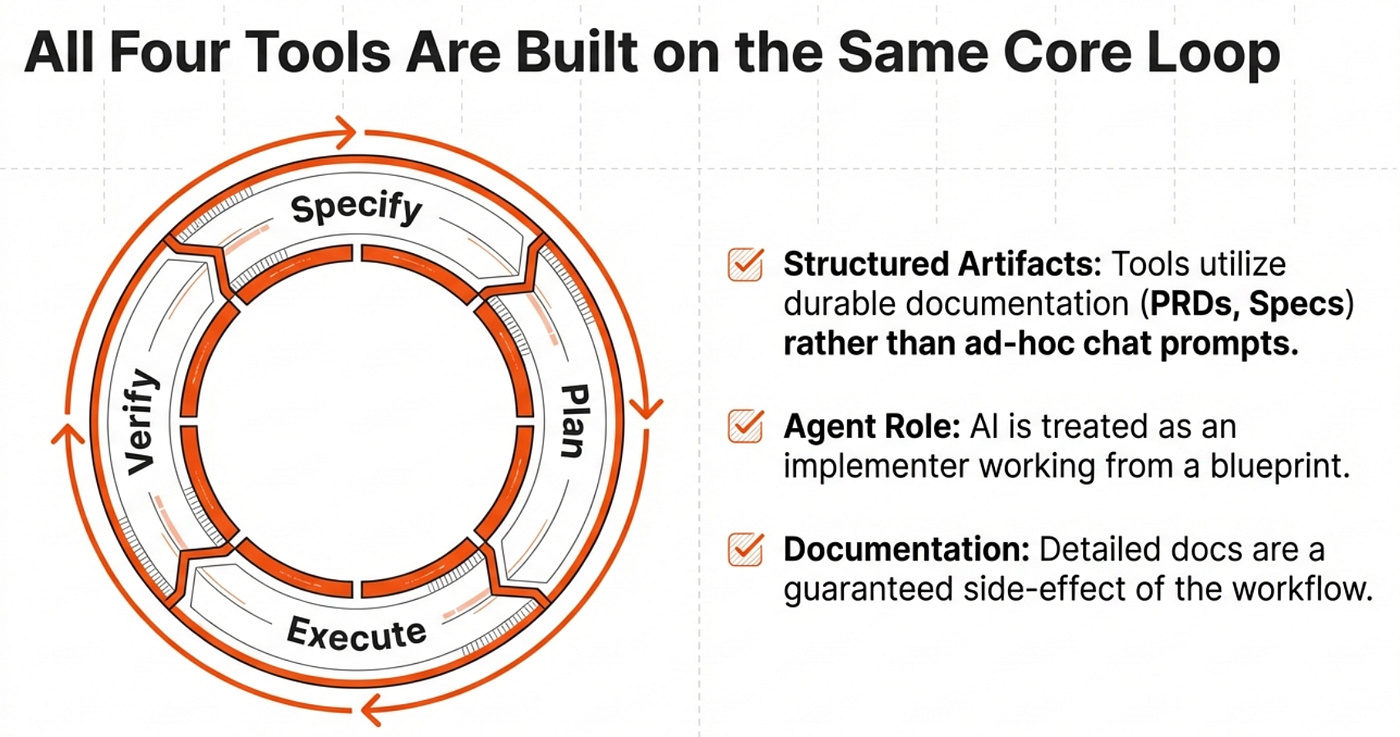
All four tools agree on a central loop: specify requirements, plan implementation, execute tasks, and verify results. All treat AI coding agents as implementers working from structured artifacts rather than ad-hoc prompts. All produce durable documentation as a side effect of their workflow.
SDD tools landscape quadrant showing GSD, Spec Kit, OpenSpec, and Taskmaster AI by execution depth and platform breadth
Beyond this shared foundation, the tools diverge in philosophy, architecture, and execution depth. These differences matter when choosing one for your workflow.
Tool Profiles
The profiles below are listed alphabetically to avoid editorial bias. Each follows the same structure: positioning, key stats, workflow summary, and differentiator.
GSD (Get “Stuff” Done)
Stars: 16.7k | License: MIT | Platforms: Claude Code, OpenCode, Gemini CLI | GitHub | npm
GSD positions itself as an execution-first, context engineering system. Its philosophy prioritizes delivering results over process overhead.
The core workflow follows four phases: discuss, plan, execute, verify. What differentiates GSD is its context isolation architecture. Each execution unit receives its own fresh context window (close to 200k tokens in Claude) built from project artifacts rather than accumulated chat history. This directly addresses “context rot,” the quality degradation that occurs when AI agents fill their context windows during long sessions.
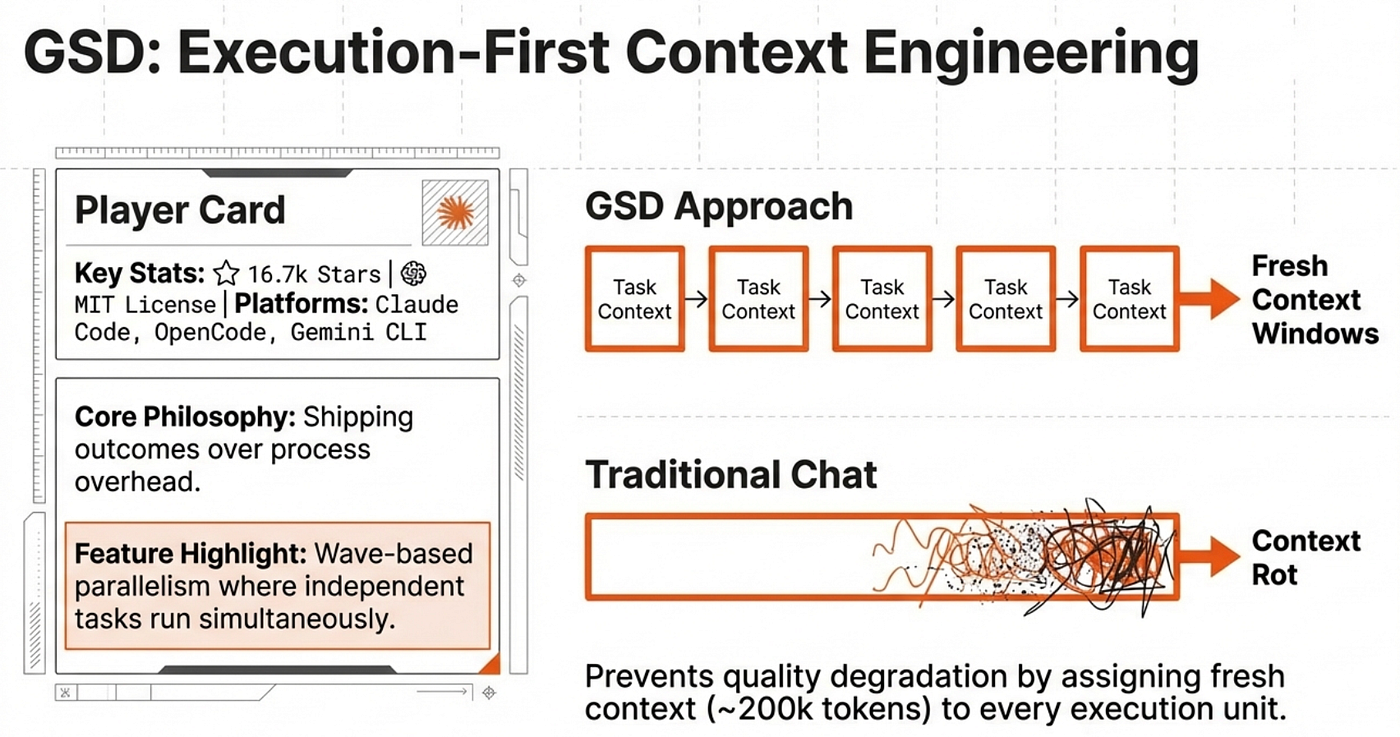
GSD deploys multiple specialized agents: four parallel researchers, a planner, a plan checker, wave-based parallel executors, verifiers, and debuggers. The execution phase supports wave-based parallelism with dependency management; independent tasks run simultaneously while dependent tasks wait.
Key commands: /gsd:discuss-phase, /gsd:plan-phase, /gsd:execute-phase, /gsd:verify-work.
OpenSpec (Fission-AI)
Stars: 24.9k | License: MIT | Platforms: 20+ AI tools | Version: 1.1.1 (Jan 2026) | GitHub | npm
OpenSpec calls itself “brownfield-first,” designed for teams working in existing codebases, not just greenfield projects. Its philosophy: “Fluid not rigid, iterative not waterfall, easy not complex.”
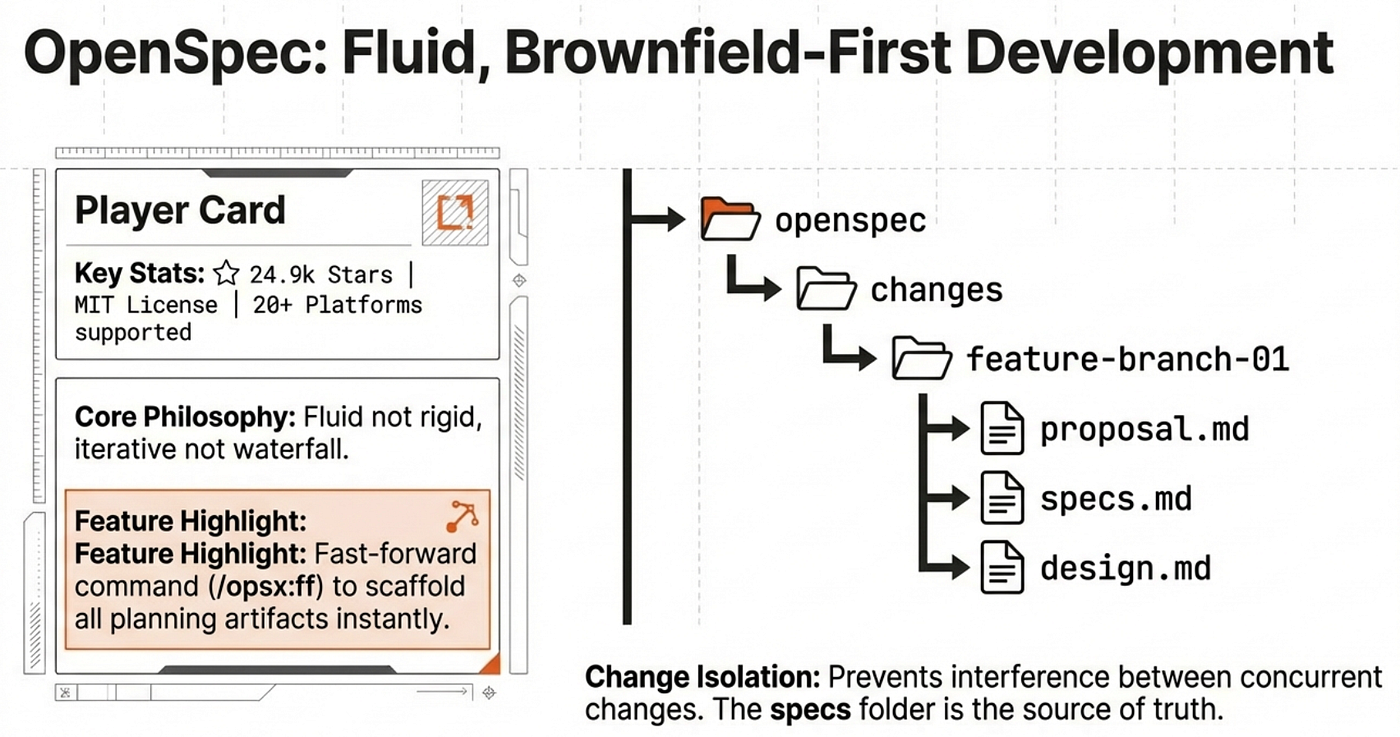
The key differentiator is change isolation. Each change gets its own folder (openspec/changes/<name>/) containing a proposal, specs, design documents, and tasks. This prevents one change from interfering with another while keeping the complete project context accessible. The specs folder serves as source of truth.
OpenSpec offers a fast-forward command (/opsx:ff) that generates all planning artifacts at once, reducing ceremony from multi-step workflows. The current command prefix is /opsx: (legacy /openspec: commands still work but are not recommended).
Key commands: /opsx:new, /opsx:ff, /opsx:apply, /opsx:verify, /opsx:archive.
Spec Kit (GitHub)
Stars: 70.8k | License: MIT | Platforms: 18+ AI coding agents | GitHub | Blog
Spec Kit is GitHub’s official entry into the SDD space, and its star count reflects the platform’s reach. The philosophy is explicit: “Specs don’t serve code; code serves specs.” Spec Kit treats the PRD not as a guide but as the source that generates implementation.
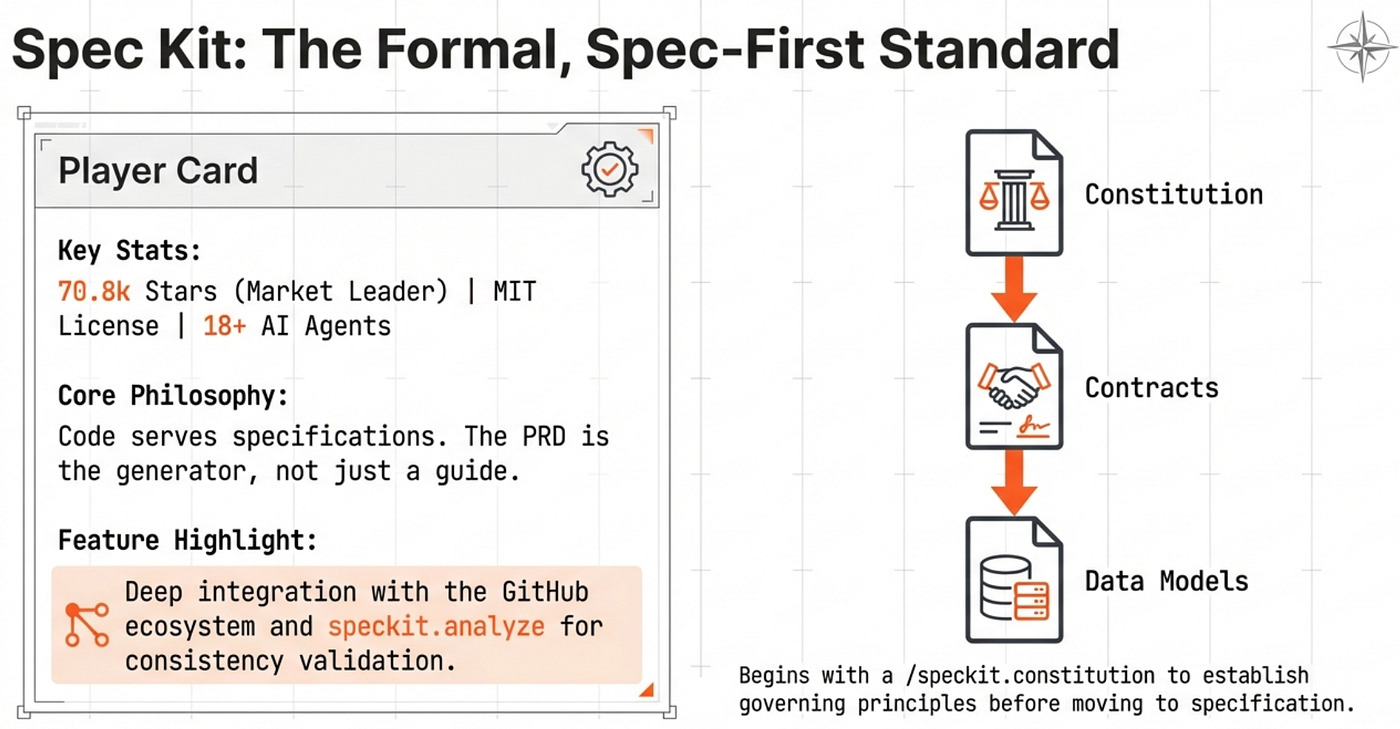
The workflow starts with a constitution (/speckit.constitution) that establishes governing principles, then moves through specification, planning, task generation, and implementation. Spec Kit produces a rich set of artifacts: spec.md, plan.md, research.md, data-model.md, contracts, and quickstart guides.
Spec Kit has execution capabilities via /speckit.implement, which uses the connected AI agent to build features from task lists. It also includes /speckit.analyze for cross-artifact consistency validation and /speckit.checklist for quality checks.
Key commands: /speckit.constitution, /speckit.specify, /speckit.plan, /speckit.implement, /speckit.analyze.
Taskmaster AI
Stars: 25.5k | License: MIT with Commons Clause | Platforms: Cursor (first-class), Windsurf, VS Code, Claude Code, Q Developer CLI | GitHub | Website
Taskmaster AI treats AI as a project manager. It parses PRDs into hierarchical task lists, with dependency awareness, then feeds these tasks to coding agents for execution. With 25.5k stars and 1,200+ commits, it’s a mature, production-grade tool.
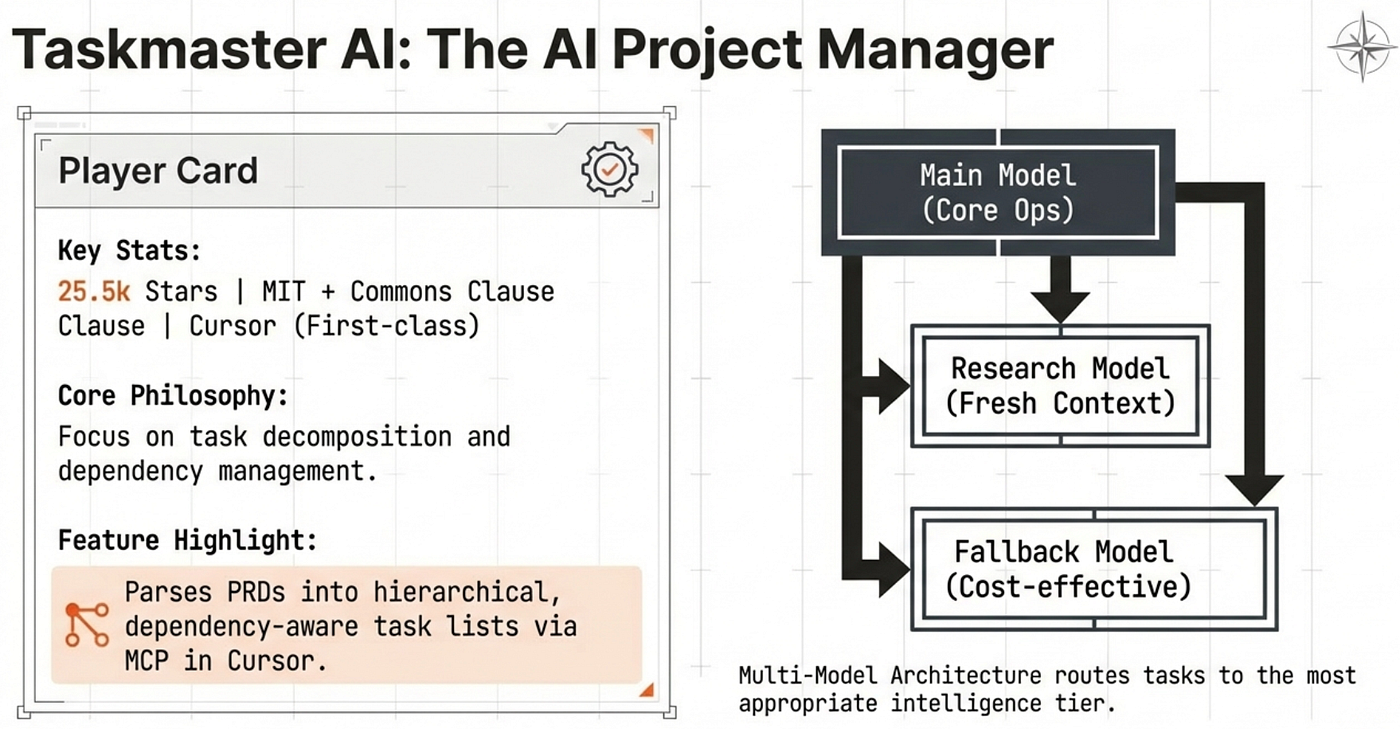
The key differentiator is its multi-model architecture. Taskmaster supports three configurable model tiers: a main model for core operations, a research model for fetching fresh web information with project context, and a fallback model. This lets you combine a powerful reasoning model with a fast research model and a cost-effective fallback.
Taskmaster’s first-class integration is with Cursor via MCP, though it also supports Windsurf, VS Code, Q Developer CLI, and Claude Code. Its focus is task decomposition and dependency management rather than complete workflow orchestration.
Note on licensing: Taskmaster uses MIT with Commons Clause, which restricts selling the software as a service. This is a significant distinction from the pure MIT licenses used by the other three tools.
Key commands: task parsing, dependency mapping, complexity analysis, research queries.
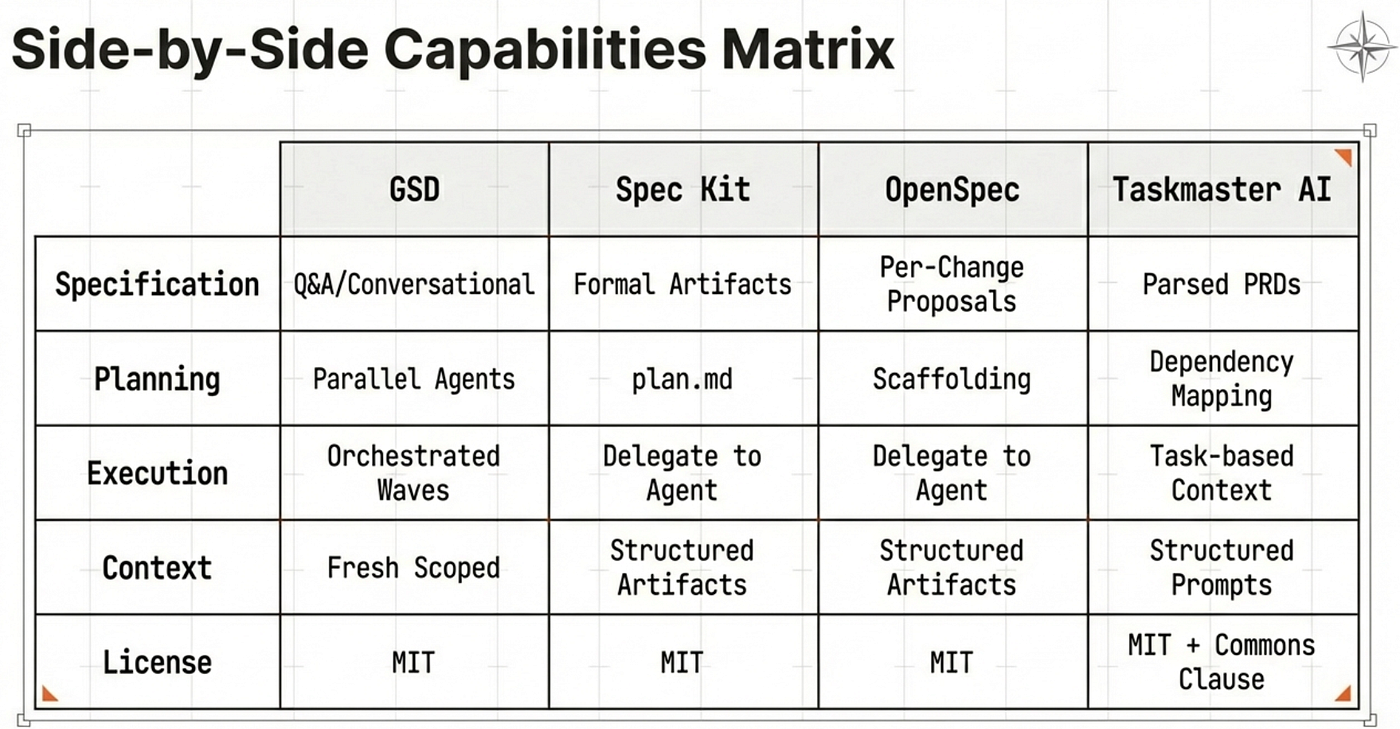
Side-by-Side Comparison
Feature comparison grid for GSD, Spec Kit, OpenSpec, and Taskmaster AI across specification, planning, execution, verification, context, and platform dimensions
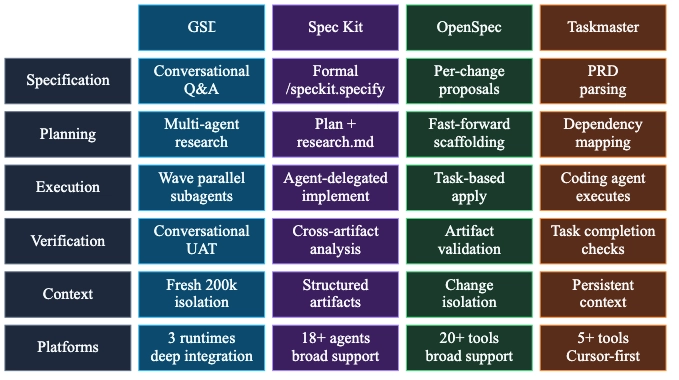
Feature Breakdown by Tool
GSD
Overview: Execution-first context engineering system with fresh context isolation per subagent
- Specification: Conversational Q&A producing PROJECT.md, REQUIREMENTS.md
- Planning: 4 parallel research agents + planner + checker
- Execution: Subagent orchestration with wave parallelism; each gets their own fresh context
- Verification: /gsd:verify-work with conversational UAT
- Context Management: Fresh scoped context per execution unit (each subagent gets their own window)
- Research: 4 integrated parallel research agents
- Platforms: 3 runtimes (Claude Code, OpenCode, Gemini CLI)
- License: MIT
- Stars (Feb 2026): 16.7k
Spec Kit
Overview: GitHub’s spec-first methodology with rich artifact generation and broad platform support
- Specification: Formal /speckit.specify producing structured artifacts
- Planning: /speckit.plan producing plan.md + research.md
- Execution: /speckit.implement delegates to connected agent
- Verification: /speckit.analyze + /speckit.checklist
- Context Management: Structured context via spec artifacts
- Research: Produces research.md artifact
- Platforms: 18+ agents (Copilot, Cursor, Windsurf, etc.)
- License: MIT
- Stars (Feb 2026): 70.8k
OpenSpec
Overview: Brownfield-first with change isolation and fluid workflow scaffolding
- Specification: Per-change proposals with specs, design, tasks
- Planning: /opsx:ff generates all artifacts at once
- Execution: /opsx:apply implements from tasks.md
- Verification: /opsx:verify validates against artifacts
- Context Management: Change isolation reduces context bloat
- Research: /opsx:explore for iterative refinement
- Platforms: 20+ AI tools via native slash commands
- License: MIT
- Stars (Feb 2026): 24.9k
Taskmaster AI
Overview: PRD-to-task decomposition with multi-model architecture and first-class Cursor integration
- Specification: PRD parsed into hierarchical tasks
- Planning: Dependency mapping + research model tier
- Execution: Task-based; coding agent executes with context
- Verification: Task completion checks
- Context Management: Persistent context with structured prompts
- Research: Dedicated research model tier with —research flag
- Platforms: 5+ tools; Cursor first-class via MCP
- License: MIT + Commons Clause
- Stars (Feb 2026): 25.5k
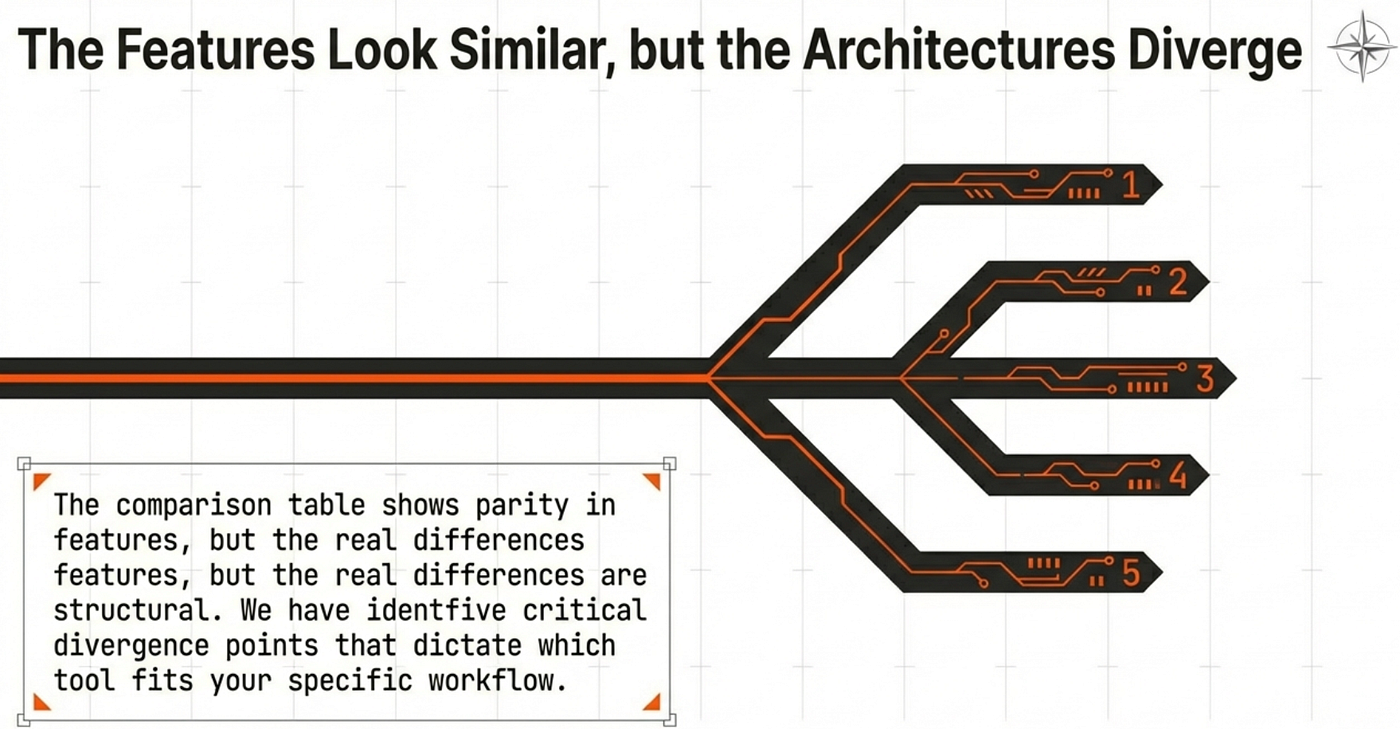
Where They Diverge
The comparison table shows capabilities side by side, but the real differences are architectural. These five divergence points matter most when choosing a tool.
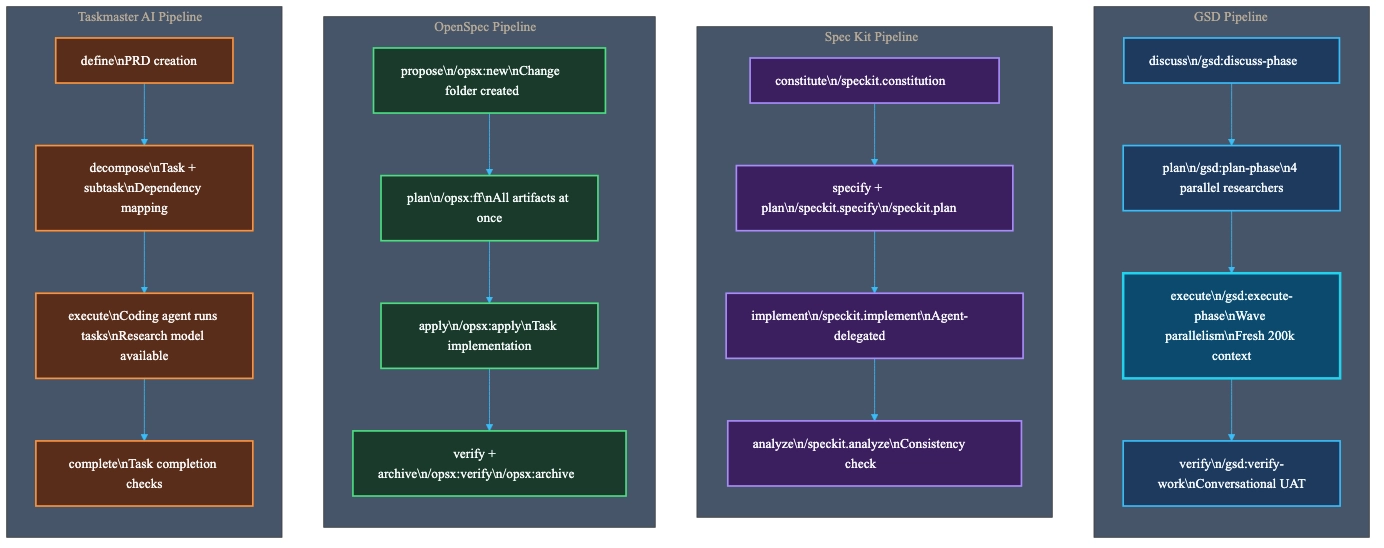
Side-by-side pipeline comparison showing how each tool moves from specification to delivered code
1. Execution Depth: Orchestration vs. Delegation
The biggest divergence is how much each tool orchestrates execution versus how much it delegates to the underlying AI agent.
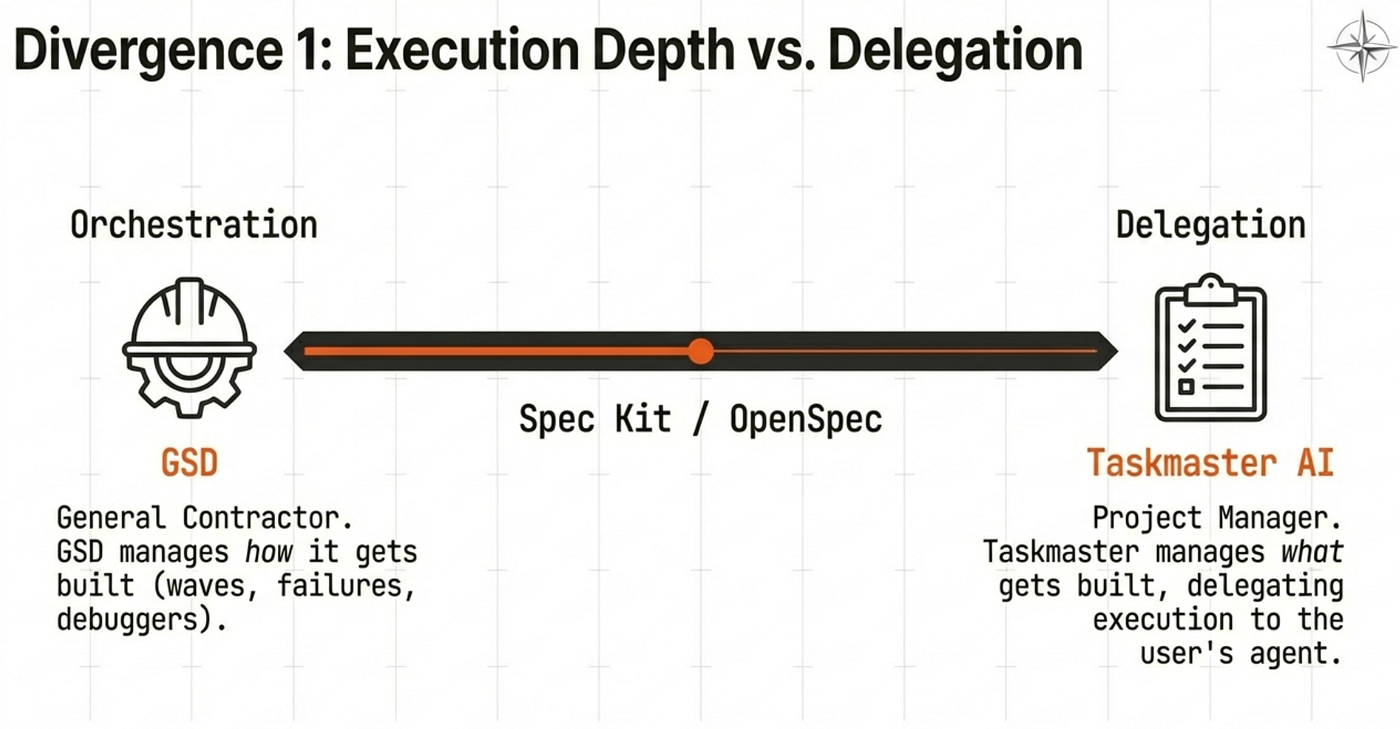
GSD is at the orchestration end of the spectrum. It manages wave-based parallel execution, assigns tasks to isolated subagent contexts, tracks dependencies between waves, and handles failures with dedicated debugger agents. The executor builds a curated context window, launches the agent, and monitors the result.
Spec Kit occupies the middle ground. Its /speckit.implement command executes tasks through the connected AI agent, but doesn’t manage parallelism or agent isolation. Orchestration lives in the specification layer: detailed specs and plans guide the agent toward good output.
OpenSpec takes a similar approach with /opsx:apply, which implements tasks from the generated task list. The tool manages what is built (via change isolation) more than how it is built.
Taskmaster AI delegates execution more completely. It excels at decomposing work into well-structured tasks with dependency graphs, then hands these tasks to whatever coding agent the developer uses. The intelligence is in the decomposition, not the execution.
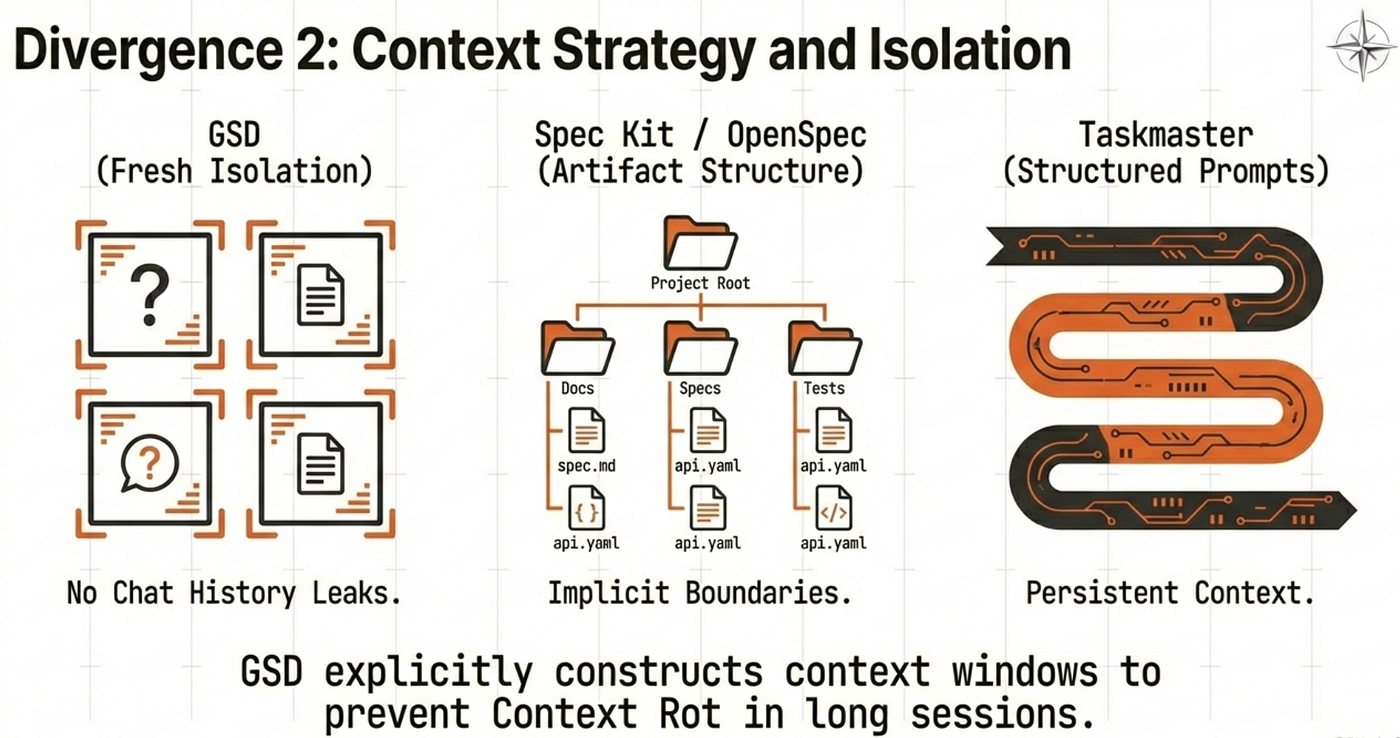
2. Context Strategy: Fresh Isolation vs. Artifact Structure
How a tool manages context determines how well it performs on projects that span multiple sessions and dozens of files.
GSD’s defining innovation is fresh context isolation. Each executor receives their own fresh context window built from project artifacts: PROJECT.md, research files, REQUIREMENTS.md, ROADMAP.md, STATE.md, and the specific PLAN.md for that task. No chat history leaks. No previous executor decision pollutes the context.
Spec Kit and OpenSpec manage context through their artifact structures. Spec Kit’s cascade of spec.md, plan.md, and research.md creates implicit context boundaries. OpenSpec’s change isolation (each change in its own folder) prevents cross-change context pollution. Both rely on the AI agent’s ability to prioritize relevant artifacts rather than explicitly curating the context window.
Taskmaster AI maintains persistent context with structured prompts. Its multi-model architecture helps by routing different operations to appropriate models, but it doesn’t implement explicit context isolation between execution units.
3. Brownfield vs. Greenfield Orientation
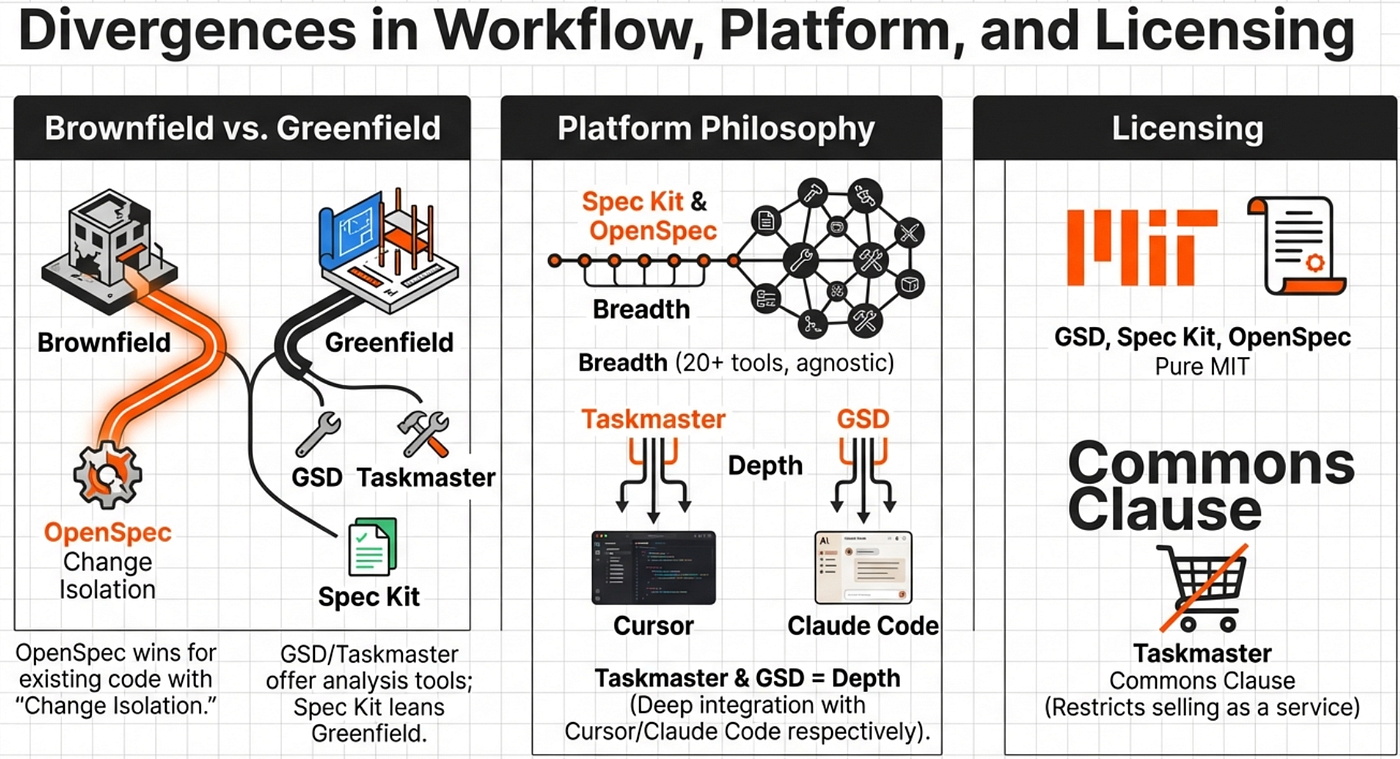
OpenSpec leads here. Its “brownfield-first” philosophy is architectural, not just branding. The change isolation structure (openspec/changes/<name>/) is designed for existing codebases where multiple changes coexist. The /opsx:explore command lets developers think through ideas before committing to implementation.
GSD offers /gsd:map-codebase to analyze existing code before initialization, making it brownfield-capable though not brownfield-first. Its brownfield support is at Spec Kit’s level.
Spec Kit supports brownfield modernization as one of its workflow phases, though its primary flow starts with a constitution and specification that feel more natural for greenfield work.
Taskmaster AI focuses on PRD-to-task decomposition, which works for both greenfield and brownfield but offers no brownfield-specific tooling.
4. Platform Philosophy: Breadth vs. Depth
Spec Kit (18+ agents) and OpenSpec (20+ tools) support the broadest range of AI coding environments. Both use slash commands that work across platforms, making them tool-agnostic choices.
Taskmaster AI takes the depth approach with Cursor as its first-class integration via MCP. It also supports Windsurf, VS Code, Q Developer CLI, and Claude Code, but the Cursor experience is the most polished.
GSD supports three runtimes (Claude Code, OpenCode, Gemini CLI) with deep integration for each, sending a conversion layer that adapts its multi-agent architecture to each runtime’s specific capabilities. Its debugging and validation tools are top notch.
5. Licensing: Open vs. Restricted
Three tools use pure MIT licenses: GSD, Spec Kit, and OpenSpec. You can use them commercially without restriction.
Taskmaster AI uses MIT with Commons Clause, which adds a restriction: you cannot sell the software itself as a commercial offering. For most developers using it as a development tool, this doesn’t matter. For companies building products that incorporate or resell task management capabilities, it’s worth noting.
When to Use Which
There is no single best tool. The right choice depends on your workflow, your platform, and what you value most.
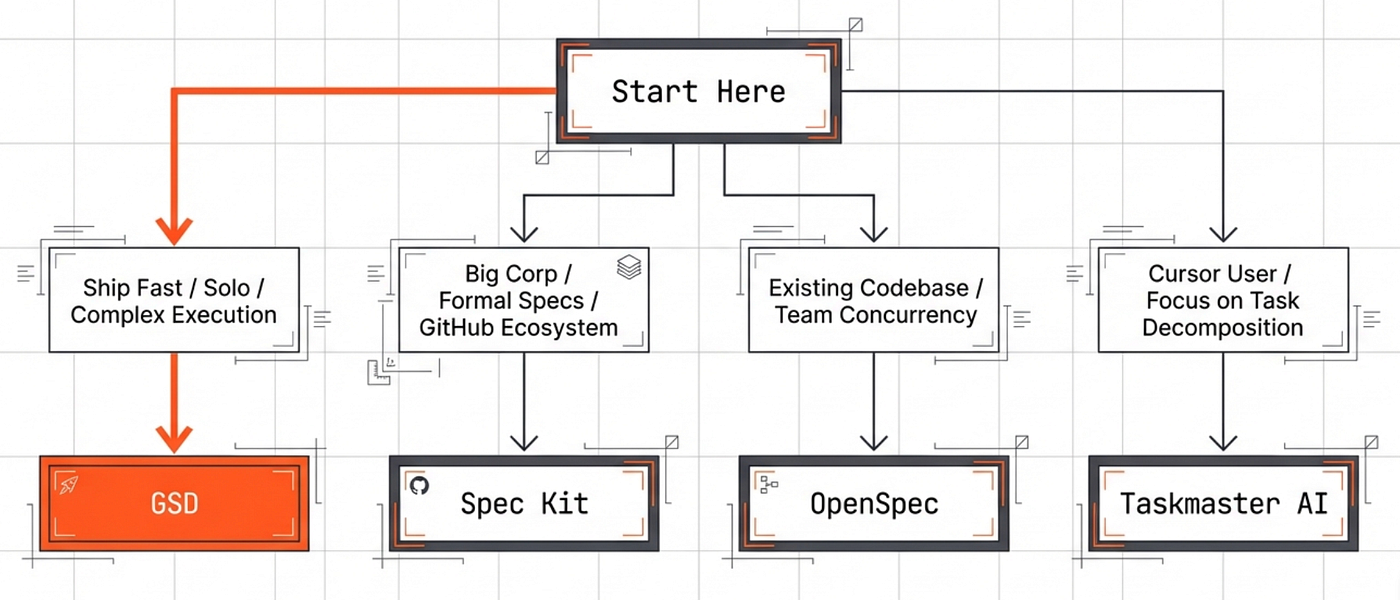
Choose GSD when:
- You want end-to-end execution orchestration, not just planning
- You’re building multi-phase projects where context isolation prevents quality degradation
- You use Claude Code, OpenCode, or Gemini CLI
- You value parallel execution with waves of dependency-aware tasks
- You’re a solo developer or small team that wants to deliver without ceremony
GSD has seamless tight integration with the coding agents it supports.
GSD has the best integration with AI agent tools. It extends and augments rather than replaces. Jumping back and forth between tools and CLIs is distracting!
GSD lets you focus.
It’s much less distracting when the tool you use acts like it simply plugs into your AI coding platform.
GSD’s sweet spot is the developer who wants the tool to manage the entire lifecycle, including execution, rather than generating specs and stepping back. It even has tools for tracking out-of-band like /gsd:add-todo, /gsd:quick, and /gsd:debug that go beyond spec-driven development and provide tools for end-to-end development (project setup, milestone-based phase delivery that integrates with git branches and PRs, etc.).
Choose Spec Kit when:
- You want a spec-first methodology backed by the GitHub ecosystem
- You work across multiple AI coding agents and need platform flexibility
- You value formal specification artifacts (constitutions, contracts, data models)
- Your team benefits from structured documentation as a primary output
- You want the largest community and broad ecosystem support (70.8k stars)
Spec Kit’s strength is its specification depth and platform breadth. If you alternate between Copilot, Cursor, and Claude Code depending on the task, Spec Kit’s support for 18+ agents gives flexibility.
Choose OpenSpec when:
- You primarily work in existing codebases (brownfield)
- You need change isolation to manage concurrent modifications
- You want a lightweight, fluid workflow without rigid phase gates
- You value tool-agnostic support across 20+ platforms
- Your team needs to agree on specs before building
OpenSpec is the natural choice for teams maintaining production codebases. Its change-per-folder architecture prevents the chaos that comes from multiple developers (or AI agents) modifying the same project simultaneously.
Choose Taskmaster AI when:
- You want PRD-to-task decomposition with dependency management
- You use Cursor as your primary IDE and want first-class MCP integration
- You need a research model tier to bring in fresh web information
- You want multi-model flexibility (main + research + fallback)
- You value task-level granularity over workflow orchestration
Taskmaster AI shines at the decomposition layer: transforming a PRD into a structured task graph, with dependency awareness. If your workflow revolves around Cursor and you want AI to act as project manager more than executor, Taskmaster is built for that.
The SDD Landscape Is Maturing
A year ago, spec-driven development was a concept with a handful of experimental implementations. Today, four spec-driven development tools with real traction offer four different answers to the same question: how should specs drive code generation?
The convergence on the core loop (specify, plan, execute, verify) suggests the basic pattern is established. The divergence in execution depth, context management, and platform strategy suggests the tooling layer is still finding its shape.
For developers evaluating these tools in 2026, the decision framework is clear. Deep execution orchestration: GSD. Spec-first breadth: Spec Kit. Brownfield change management: OpenSpec. Task decomposition in Cursor: Taskmaster AI.
All four are actively maintained, all are growing, and all are open source. The best choice is the one that fits how you already work.
Sources (all verified February 2026):
- GSD: GitHub | npm
- Spec Kit: GitHub | GitHub Blog
- OpenSpec: GitHub | npm
- Taskmaster AI: GitHub | Website
About the Author
Rick Hightower is a technology executive and data engineer who led ML/AI development at a Fortune 100 financial services company. He created skilz, the universal skill installer for agents, supporting 30+ coding agents including Claude Code, Gemini, Copilot, and Cursor, and co-founded the world’s largest agentic skills marketplace.